

Industrial Butterfly Valves
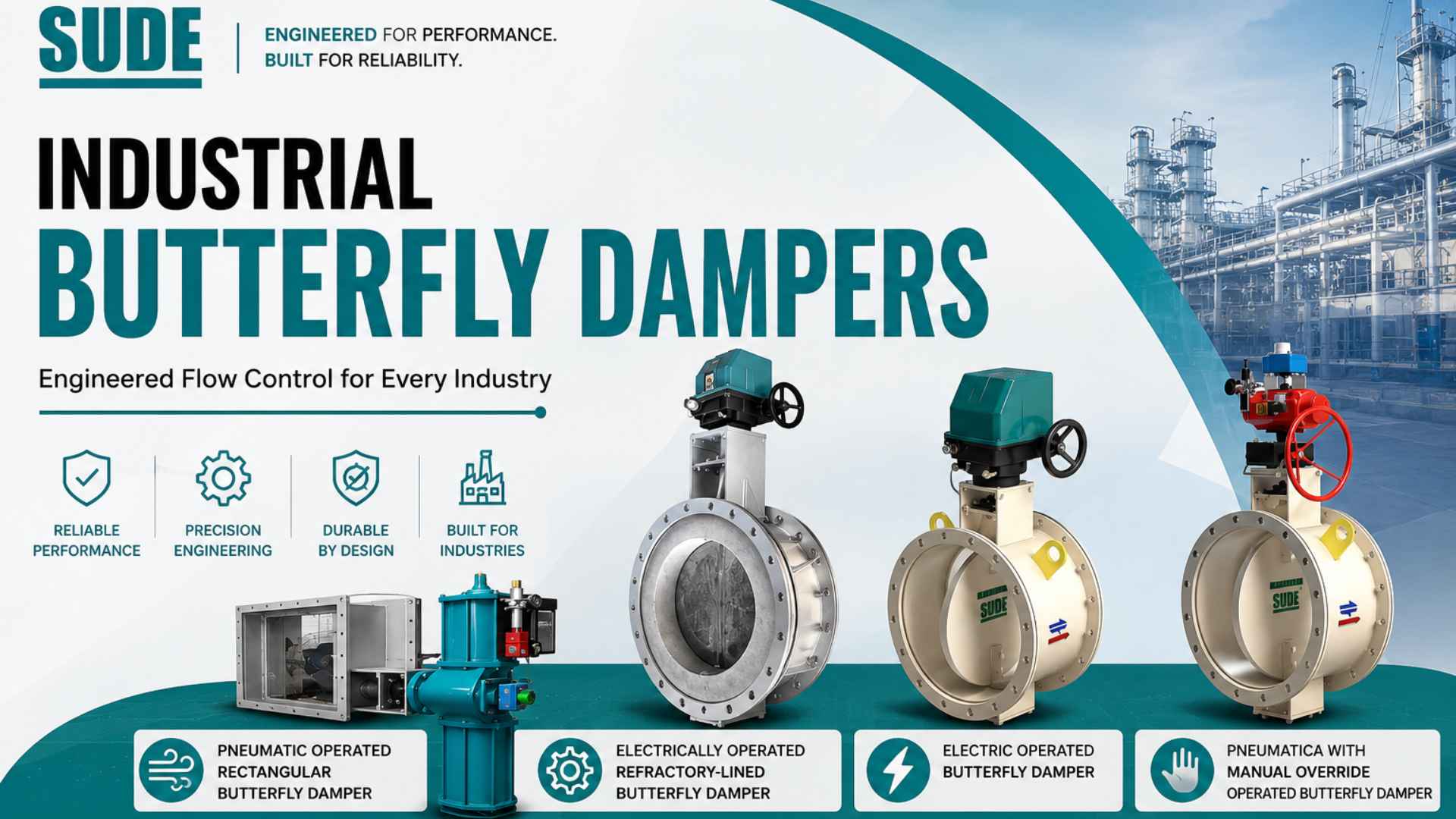
- Damper
- Jul 06, 2026
- 107 Views
Industrial Butterfly Valves
Industrial Butterfly Valves: Types, Applications, Materials and Selection Guide
Industrial flow-control systems need valves that can operate reliably, efficiently, and repeatedly under demanding process conditions. From water and wastewater systems to chemical processing, HVAC, power generation, pharmaceuticals, and general industrial utilities, industrial butterfly valves are widely used for flow isolation and control.
Their compact design, quarter-turn operation, relatively low weight, and suitability for automated operation make butterfly valves a practical choice for many medium- and large-diameter applications. SUDE Engineering manufactures pneumatic- and electric-operated butterfly valves in metal and plastic configurations for industrial applications including water distribution, chemical processing, HVAC, power plants, wastewater treatment, and general utilities.
However, not every butterfly valve is suitable for every service. Valve type, body and disc material, pressure and temperature, sealing arrangement, media compatibility, actuation, and installation conditions all influence the right selection.
This guide explains how industrial butterfly valves work, the main types available, where they are used, and what buyers should consider when choosing a butterfly valve manufacturer.
What Are Industrial Butterfly Valves?
A butterfly valve is a quarter-turn rotary valve that uses a disc mounted on a shaft to control flow.
When the valve is fully open, the disc rotates so that it presents relatively little obstruction to the flowing media. When the disc rotates through approximately 90 degrees to the closed position, it blocks the flow passage.
This simple operating principle allows butterfly valves to provide fast on-off operation while also being used for certain modulating applications.
SUDE's product literature describes butterfly valves as quarter-turn valves and offers configurations with pneumatic double-acting or spring-return actuators, as well as electric operation.
How Do Butterfly Valves Work?
The operation of a butterfly valve can be divided into three basic positions.
Fully Open
The disc is rotated approximately parallel to the flow path, allowing the media to pass through the valve.
A correctly selected butterfly valve can provide relatively low resistance to flow in the open position.
Partially Open
The disc rotates through an intermediate position, restricting the available flow area.
This allows the valve to be used for certain flow-control or throttling applications. The actual suitability of a valve for continuous modulation depends on its design, flow characteristics, pressure drop, and process requirements.
Fully Closed
The disc rotates approximately 90 degrees from the fully open position and engages the sealing arrangement to isolate the flow path.
The sealing design and material determine the valve's leakage performance and temperature and chemical compatibility.
Why Are Industrial Butterfly Valves Widely Used?
Butterfly valves are popular in industrial systems because they offer a combination of compact construction and simple quarter-turn operation.
Compact Design
Compared with many multi-turn valve arrangements, butterfly valves can provide a space-efficient flow-control solution.
This can be particularly useful in plants where installation space is limited.
Fast Operation
Quarter-turn operation allows rapid opening and closing. This also makes butterfly valves well suited to pneumatic and electric automation.
Lower Weight
Butterfly valves can be relatively lightweight, particularly for larger line sizes. This can simplify installation and may reduce the mechanical requirements of associated piping supports.
Automation Ready
Modern industrial facilities increasingly automate valve operation. SUDE provides both pneumatic and electric-operated butterfly valve configurations, allowing the valve to be integrated into automated process systems.
Broad Application Range
Butterfly valves can be used for water, air, gases, chemicals, wastewater, HVAC systems, and other industrial services when the valve materials and design are appropriate for the process.
Types of Industrial Butterfly Valves
The term industrial butterfly valves covers several different designs. Understanding the differences is important because selection should be based on the service rather than the valve name alone.
Concentric Butterfly Valves
In a concentric design, the shaft and disc arrangement is centred relative to the valve body and sealing geometry.
These valves are commonly used for general isolation and utility applications where pressure, temperature, and leakage requirements are compatible with the design.
Double Offset Butterfly Valves
In a double offset design, the shaft is offset relative to the centreline of the disc and sealing geometry.
The offset movement can reduce contact between the disc and seat during much of the opening and closing cycle. This can help reduce friction and sealing wear compared with simpler concentric designs.
Double offset designs are often considered for more demanding applications requiring improved shut-off performance and reduced operating torque.
Triple Offset Butterfly Valves
Triple offset butterfly valves add another geometric offset to the sealing arrangement, creating a cam-like movement that minimises rubbing between the disc and seat.
They are commonly considered for demanding services involving higher temperature, pressure, or critical isolation requirements.
SUDE's product portfolio includes a Triple Eccentric Butterfly Valve Series 1921 designed for high-temperature, high-pressure, and corrosive industrial environments. The company lists applications including power plants, refineries, steel manufacturing, process industries, industrial ducts, combustion air, and exhaust systems.
Metal vs. Plastic Butterfly Valves
Material selection is one of the most important aspects of butterfly valve selection.
Metal Butterfly Valves
Metal-bodied butterfly valves can be used in a broad range of industrial services where higher mechanical strength, temperature resistance, or process compatibility is required.
Depending on the service, materials may include carbon steel, ductile iron, stainless steel, or other alloys.
Stainless Steel Butterfly Valves
A stainless steel butterfly valve may be preferred where corrosion resistance, hygiene, or compatibility with aggressive process media is important.
Stainless-steel construction is particularly relevant in chemical, pharmaceutical, food, water, and other environments where material compatibility is a major consideration.
The correct stainless-steel grade should still be selected according to the actual media, temperature, concentration, chloride exposure, and process conditions.
Plastic Butterfly Valves
Plastic valves can provide excellent corrosion resistance for selected chemical and water services while also offering low weight.
SUDE's butterfly valve portfolio includes plastic butterfly valves manufactured using materials such as PVC, CPVC, PP, and PVDF. The company positions these valves for chemical and water services where corrosion resistance is important.
Wafer, Lug and Flanged Butterfly Valves
The connection method is another major consideration.
Wafer Butterfly Valves
A wafer butterfly valve is installed between pipeline flanges and is generally designed as a compact and economical arrangement.
Because of its compact dimensions, it is frequently considered where space and weight are important.
However, buyers should confirm the required pressure class, flange compatibility, installation standards, and pipeline configuration before selecting a wafer design.
Lug Butterfly Valves
Lug-style butterfly valves use threaded or tapped lugs around the body. This can allow the valve to remain independently supported between pipe flanges and can be useful in certain maintenance arrangements.
Flanged Butterfly Valves
Flanged configurations use integral flanges that connect directly to the pipeline.
They may be selected for applications where the project specification requires a flanged connection or where additional mechanical rigidity is needed.
The best connection type depends on line size, pressure rating, maintenance requirements, piping design, and applicable standards.
What Is a Wafer Butterfly Valve Manufacturer?
A wafer butterfly valve manufacturer designs and produces butterfly valves specifically configured for installation between pipeline flanges.
The manufacturer's responsibility should include more than producing the valve body. It should also include correct disc and shaft design, sealing selection, dimensional accuracy, testing, quality inspection, and compatibility with the specified piping system.
When buying wafer butterfly valves, engineers should verify:
Valve size
Pressure class
Body material
Disc material
Shaft material
Seat material
Face-to-face dimensions
Flange compatibility
Temperature range
Leakage requirements
Actuation requirements
This is particularly important because a physically compatible valve may still be unsuitable if its pressure, temperature, seat, or material specifications do not match the application.
Applications of Industrial Butterfly Valves
The versatility of butterfly valves makes them common across several industrial sectors.
Water and Wastewater
Butterfly valves are widely used in water distribution, treatment, and wastewater systems for isolation and flow control.
SUDE identifies water distribution and wastewater treatment among the applications of its butterfly valve range.
Chemical Processing
Chemical systems can require corrosion-resistant valve materials and carefully selected sealing components.
Plastic butterfly valves manufactured from PVC, CPVC, PP, or PVDF may be considered for compatible chemical services, while metallic designs may be more appropriate for other process conditions.
HVAC
Large HVAC systems often require compact isolation and air or water flow-control solutions.
Butterfly valves can be used in chilled-water, cooling-water, and utility systems when appropriately specified.
Power Generation
Power plants use valves throughout cooling, water, auxiliary, fuel, air, and process systems.
For higher-temperature and higher-pressure applications, engineers may consider double- or triple-offset butterfly valve designs depending on the operating conditions.
SUDE identifies power plants as an application for its butterfly valve range and separately offers a triple-offset design for demanding high-temperature and pressure applications.
Pharmaceutical Industry
Pharmaceutical processes can require hygienic materials, controlled surface finishes, cleanability, and reliable automation.
The choice of butterfly valve should depend on whether the application involves general utilities or direct hygienic process contact.
SUDE's broader portfolio includes dedicated hygienic valve products for pharmaceutical applications, showing that valve selection within a pharmaceutical plant needs to be based on the specific service rather than assuming one valve type is suitable for every line.
General Industrial Utilities
Compressed air, cooling water, fire water, process water, ventilation, and other utility systems can use butterfly valves where their pressure, temperature, and sealing characteristics are suitable.
How to Select the Right Industrial Butterfly Valve
Selecting the correct valve starts with the process conditions.
1. Identify the Media
Determine whether the valve will handle:
Water
Air
Steam
Gas
Chemical liquids
Wastewater
Slurries
Process fluids
The media directly affects body, disc, seat, gasket, and coating selection.
2. Check Pressure and Temperature
Pressure and temperature should be considered together.
A valve's allowable operating range depends on its design, materials, sealing arrangement, and applicable pressure-temperature rating.
3. Determine the Required Shut-Off Performance
Some systems require basic isolation, while others need very low leakage or tight shut-off.
A resilient-seated butterfly valve may be suitable for many utility applications, while a metal-seated or triple-offset configuration can be considered for more demanding service.
4. Consider Flow Characteristics
For modulating applications, engineers need to understand the relationship between disc position and flow.
A valve that is excellent for isolation is not automatically the best choice for continuous throttling.
5. Select the Correct Material
Material selection should be based on:
Corrosion
Temperature
Pressure
Abrasion
Chemical concentration
Hygiene requirements
Expected service life
A stainless steel butterfly valve may be appropriate for certain corrosive or hygienic applications, but the specific grade must match the process.
6. Choose Manual or Automated Operation
Manual operation can be practical for infrequent isolation.
For frequent cycling or remote control, pneumatic or electric actuators may be more appropriate.
SUDE offers pneumatic and electric-operated butterfly valves, including configurations designed for automation and fail-safe operation.
7. Check Installation Requirements
Consider:
Available installation space
Pipe alignment
Flange type
Valve orientation
Maintenance access
Actuator clearance
Future replacement requirements
These factors should be confirmed before finalising the valve.
Pneumatic vs. Electric Butterfly Valve Actuation
Automation is increasingly important in modern industrial plants.
Pneumatic Actuation
Pneumatic actuators can provide rapid quarter-turn operation and are often used where compressed air is readily available.
They are particularly useful for repetitive on-off applications and can be configured with accessories for position indication, control, and fail-safe operation.
Electric Actuation
Electric actuators can be useful where electrical power is available and remote positioning, feedback, or modulating control is required.
They can integrate into automated process-control systems through suitable control interfaces.
SUDE's portfolio includes both pneumatic and electric-operated butterfly valves, providing flexibility when selecting an automation arrangement.
How a Butterfly Valve Manufacturer Supports Project Requirements
A good butterfly valve manufacturer should be able to support the valve throughout the engineering and procurement process.
That can include:
Valve sizing
Material selection
Technical drawings
Actuator sizing
Pressure and leakage testing
Inspection documentation
Custom dimensions
Special coatings or materials
Position feedback
Automation accessories
Installation guidance
The manufacturer's engineering capability becomes especially important when valves are part of a larger automated flow-control system.
SUDE Engineering states that it specialises in valves, dampers, and actuation systems and has more than 40 years of engineering experience. Its manufacturing facilities are located in Alandi, Pune, while its operations support customers across India and international markets.
Quality and Testing of Butterfly Valves
Quality control is essential because a valve that leaks, binds, or fails to operate can affect the reliability of the complete process system.
Depending on the valve and project requirements, quality checks can include:
Dimensional inspection
Pressure testing
Seat leakage testing
Functional testing
Material verification
Actuator testing
Visual inspection
Documentation and traceability
The exact tests should be specified according to valve type, service, applicable standards, and the customer's technical requirements.
SUDE states that its products undergo inspection and testing and that the company maintains quality systems and certifications including ISO 9001:2015, ISO 14001:2015, and ISO 45001:2018.
Why Choose SUDE Engineering for Industrial Butterfly Valves?
SUDE Engineering's butterfly valve portfolio includes pneumatic and electric-operated metal and plastic butterfly valves.
The company highlights applications across water distribution, chemical processing, HVAC, power generation, wastewater treatment, and general industrial utilities.
For more demanding applications, SUDE also offers high-performance triple eccentric butterfly valve technology for high-temperature, high-pressure, and corrosive environments.
Its broader flow-control portfolio covers valves, dampers, and actuators, which can simplify engineering when a project requires coordinated valve automation rather than a standalone manual valve.
With manufacturing capability in Pune and more than four decades of engineering history, SUDE can support domestic as well as international industrial requirements.
Frequently Asked Questions
What are industrial butterfly valves used for?
Industrial butterfly valves are commonly used for flow isolation and, where appropriately designed, flow regulation in water, chemical, HVAC, wastewater, power, and other industrial systems.
What is a stainless steel butterfly valve?
A stainless steel butterfly valve uses stainless steel for all or selected major components such as the body or disc. It can be considered where corrosion resistance, durability, or hygienic requirements make stainless steel appropriate.
What is a wafer butterfly valve?
A wafer butterfly valve is designed to be installed between pipeline flanges. Its compact construction makes it suitable for many applications where space and weight are important considerations.
How do I choose a butterfly valve manufacturer?
Consider the manufacturer's engineering capability, product range, materials, testing, pressure and temperature expertise, actuation options, customisation, documentation, quality systems, and after-sales support.
Are butterfly valves suitable for high-pressure applications?
Some butterfly valve designs are suitable for high-pressure service, but the correct design depends on pressure, temperature, media, sealing arrangement, and applicable standards. Double- and triple-offset designs may be considered for more demanding applications. SUDE's Triple Eccentric Butterfly Valve Series 1921 is specifically positioned for high-temperature and high-pressure industrial service.
Does SUDE manufacture butterfly valves in India?
Yes. SUDE Engineering manufactures valves and has modern manufacturing facilities in Alandi, Pune, Maharashtra.
Conclusion
Industrial butterfly valves offer a practical combination of compact construction, quarter-turn operation, automation capability, and broad application flexibility. Their suitability ranges from general utility systems to demanding industrial processes, depending on the valve design and materials selected.
The right valve should be selected by considering the complete process: media, pressure, temperature, flow requirement, leakage performance, installation arrangement, materials, operating frequency, and automation requirements.
For applications requiring a butterfly valve manufacturer, stainless steel butterfly valve, or wafer butterfly valve manufacturer, the most important consideration is not simply the lowest purchase price. Technical engineering, testing, material selection, lifecycle reliability, and application support can have a much greater impact on long-term performance.
SUDE Engineering provides industrial butterfly valve solutions in pneumatic and electric configurations, with metal and plastic options for a range of industrial services. Its broader portfolio of valves, dampers, and actuators allows customers to develop integrated flow-control and automation solutions for demanding plants.
Explore SUDE Engineering Butterfly Valve Solutions:
https://www.sudeengg.com/products/butterfly-valve
Related Posts
- Sep 30, 2026
- SUDE
- 10
Industrial Butterfly Dampers: Efficient Flow Control for Industries
Explore More
- Sep 18, 2026
- SUDE
- 10