
Industrial Diverter Damper: Series 1905, Working Principle & Applications
- Damper
- Oct 31, 2026
- 3 Views
Industrial Diverter Damper: Series 1905, Working Principle & Applications
Industrial plants often operate with complex ducting systems that carry hot gases, exhaust streams, process gases and air between different sections of a facility. In such systems, controlling the direction of gas flow is essential for maintaining operational flexibility and managing different process requirements.
An industrial diverter damper is designed to redirect gas or air between different flow paths or isolate a particular section of a ducting system when required.
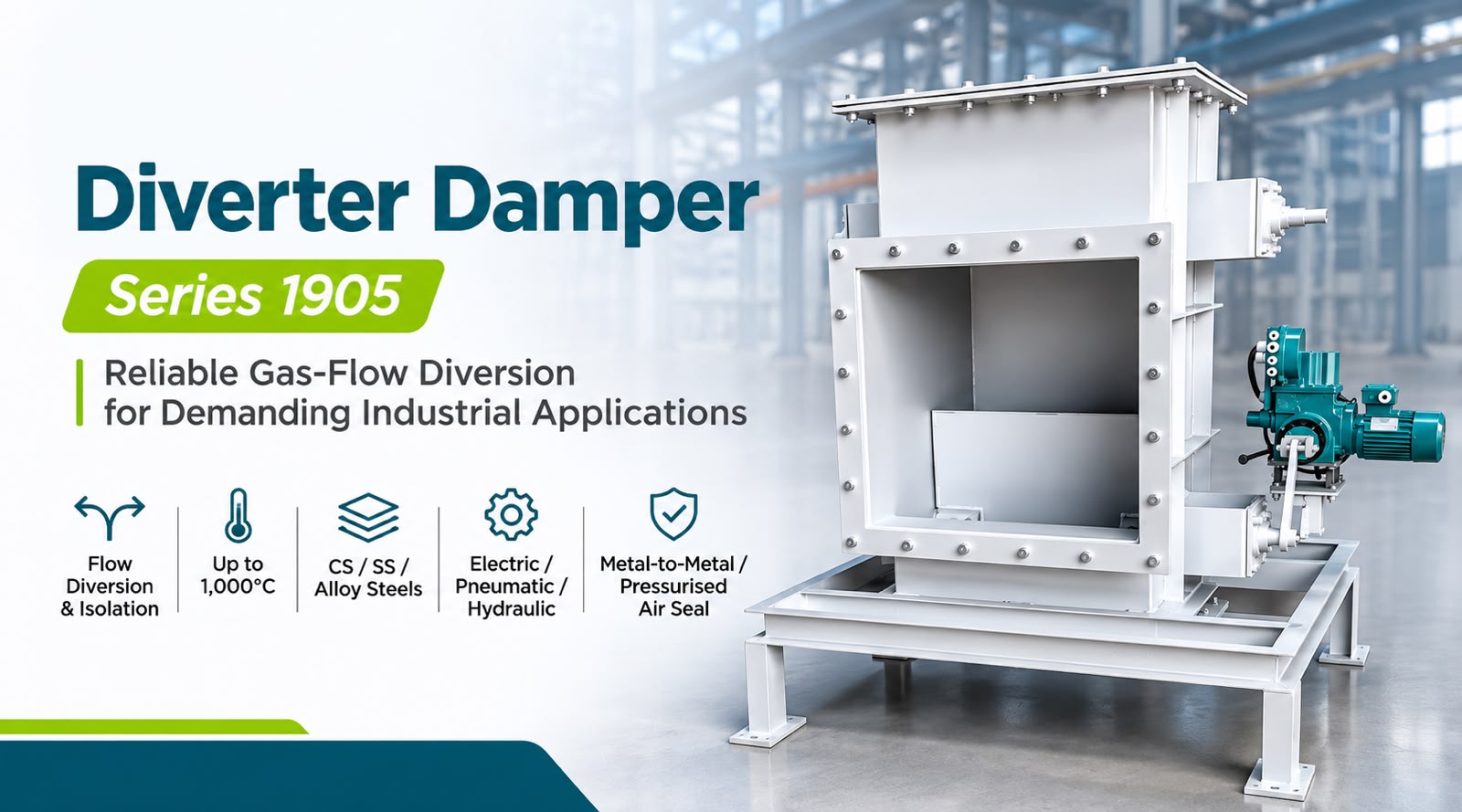
SUDE Engineering Pvt. Ltd. designs and manufactures Diverter Damper – Series 1905, a heavy-duty solution developed for gas-flow diversion, isolation and control in large industrial ducting systems.
With rotating or sliding blade mechanisms, customized configurations and multiple actuation options, SUDE Diverter Dampers are designed for demanding industrial applications involving power plants, gas turbine exhaust systems, waste heat recovery units, refineries, cement plants and steel plants.
What Is an Industrial Diverter Damper?
An industrial diverter damper is a mechanical device used to redirect the movement of gases or air between multiple outlets or alternative flow paths.
Unlike conventional isolation dampers that primarily open or close a duct passage, a diverter damper is designed to change the direction of the flowing media according to the requirements of the process.
SUDE Diverter Damper Series 1905 uses a robust rotating or sliding blade mechanism to manage gas movement through large industrial ducting systems.
The design can be configured according to duct geometry, operating conditions and the required flow arrangement.
Industrial diverter dampers are particularly relevant in applications involving:
Gas turbine exhaust systems
Power generation plants
Waste heat recovery units (WHRU)
Refineries
Cement manufacturing plants
Steel manufacturing facilities
Industrial ventilation systems
Air pollution control systems
The appropriate configuration depends on the process requirements, gas characteristics, operating temperature, pressure and sealing requirements.
How Does a Diverter Damper Work?
The working principle of an industrial diverter damper involves controlled blade movement to redirect or isolate the gas stream.
SUDE Series 1905 uses rotating or sliding flat-plate blade arrangements depending on the required application.
Its operation can be understood through three stages.
1. Open Position
In the open position, the blade is aligned to allow gas to flow freely through the main duct path.
The arrangement maintains the intended gas-flow route through the connected industrial system.
2. Closing and Diversion Movement
When a change in the process flow path is required, the actuator operates the blade mechanism.
Depending on the configuration, the blade rotates or slides into the required position, beginning to redirect or isolate the gas stream.
3. Closed or Diverted Position
In the final position, the blade either blocks the original gas passage or redirects the gas toward the designated alternative outlet.
The sealing arrangement helps achieve the required shut-off performance during isolation.
SUDE provides metal-to-metal sealing and pressurised air sealing options according to application requirements.
Technical Specifications of SUDE Diverter Damper Series 1905
SUDE Engineering's Series 1905 is designed for large industrial ducting systems that require customized gas-flow diversion and isolation arrangements.
The published product specifications include:
Parameter | Specification |
|---|---|
Product Series | 1905 |
Available Shapes | Rectangular or Circular |
Size Range | Available from 200 mm and beyond 3,000 mm |
Flow Media | Flue Gas, Process Gas and Air |
Blade Type | Flat Plate – Rotating or Sliding |
Sealing Efficiency | High Sealing Integrity |
Sealing Options | Zero-Leakage Options Available |
Sealing Type | Metal-to-Metal or Pressurised Air Seal |
Temperature Range | Up to 1,000°C with cooling and alloy options |
Material of Construction | Carbon Steel, Stainless Steel or High-Temperature Alloys |
Pressure Rating | Low to Moderate Pressure Systems |
Drive Operations | Electric, Pneumatic and Hydraulic Actuation |
Testing Standards Listed | AMCA 511, ASME AG-1, API 609, ANSI FCI 70-2 |
Design Standards Listed | ASME B16.34, ISO 5752, BS EN 558, API 609 |
These specifications are based on SUDE's published Series 1905 product information. The final configuration is determined according to project requirements and operating conditions.
For detailed product information, visit the SUDE Diverter Damper Series 1905.
Types and Configurations of Industrial Diverter Dampers
Industrial diverter dampers can be configured according to the duct arrangement, gas-flow requirements and operating mechanism.
SUDE offers different product configurations within its Series 1905 range.
Electric Operated Rectangular Diverter Damper
This configuration uses an electric actuator to operate the diverter mechanism. It is suitable for industrial installations requiring motorized operation and integration with automated systems.
Diverter Damper with Manual Override
A manual override arrangement provides an additional operating option for selected configurations.
This can be useful where an alternative means of operating the equipment is required.
Motorised Diverter Damper
Motorized configurations use an electrically driven operating mechanism to move the damper blade between the required positions.
Pneumatic Cylinder Operated Diverter Damper
This arrangement uses a pneumatic cylinder to operate the blade mechanism.
Pneumatic Diverter Damper
Pneumatic actuation provides an alternative operating arrangement for applications where compressed air is available and suitable for the required operating conditions.
The final operating mechanism depends on the size, torque requirements and process specifications of the installation.
Importance of Diverter Dampers in Power Generation
Power generation facilities require dependable equipment for managing exhaust gases, air and other process streams.
Gas turbine exhaust systems and waste heat recovery units are among the applications specifically identified by SUDE for its Diverter Damper Series 1905.
A diverter damper helps redirect gas flow between designated process routes according to the system configuration.
In industrial installations, this makes it important to consider:
Required gas-flow direction
Duct dimensions and configuration
Operating temperature
Pressure conditions
Blade movement and operating mechanism
Sealing requirements
Actuation and automation arrangements
SUDE's Power Generation Industry solutions include diverter dampers alongside guillotine dampers, butterfly dampers, isolation dampers, throttle dampers and other industrial flow-control equipment.
Industrial Applications of Diverter Dampers
1. Gas Turbine Exhaust Systems
Gas turbine installations involve exhaust gas handling through dedicated ducting arrangements.
Diverter dampers are used to redirect exhaust streams between designated flow paths according to the plant configuration.
SUDE identifies gas turbine exhaust systems as one of the primary application areas for its Series 1905.
2. Power Generation Plants
Power generation facilities require reliable flow-control equipment to manage different gas-handling and exhaust applications.
SUDE provides diverter dampers for power plants, with customized configurations designed according to project requirements.
Explore SUDE's Energy & Power Generation solutions.
3. Waste Heat Recovery Units (WHRU)
Waste heat recovery units use heat from process gases or exhaust streams for recovery and utilization.
Diverter dampers can support the management of gas flow through designated ducting arrangements.
SUDE identifies waste heat recovery units among the applications for its Series 1905.
4. Refineries and Petrochemical Industries
Refineries and petrochemical facilities operate complex industrial process systems involving gases and other process media.
Diverter dampers can be used in suitable ducting and gas-management applications where flow redirection or isolation is required.
Explore SUDE's Oil & Gas industry solutions.
5. Cement Manufacturing Plants
Cement manufacturing facilities operate with demanding process conditions involving dust, high temperatures and large gas-handling systems.
Suitable industrial dampers are important for managing air and gas movement throughout different sections of the plant.
SUDE includes Diverter Dampers in its Cement & Steel industry product portfolio.
6. Steel and Metallurgical Industries
Steel manufacturing facilities require durable flow-control equipment for demanding industrial operating environments.
Diverter dampers can be considered for applications involving industrial gas management and alternative ducting arrangements.
7. Industrial Ventilation and Air Pollution Control
Industrial ventilation and air pollution control systems involve the movement and management of air and process gases.
Diverter dampers can help redirect gas streams between designated routes according to the system design.
Sealing Arrangements in Industrial Diverter Dampers
Sealing performance is an important consideration in industrial gas-flow diversion and isolation applications.
SUDE Series 1905 offers two published sealing arrangements.
Metal-to-Metal Sealing
Metal-to-metal sealing uses specially designed metallic contact surfaces to provide the required sealing performance when the damper reaches its operating position.
Pressurised Air Sealing
Pressurised air sealing is another option available for applications requiring enhanced isolation performance.
The selection of a suitable arrangement depends on the required leakage performance, process conditions and damper configuration.
SUDE also identifies zero-leakage options within its Series 1905 product specifications. The actual performance must be established against the applicable project requirements and test conditions.
Actuation Options for Diverter Dampers
The actuation system controls the movement of the diverter damper blade.
SUDE Series 1905 supports electric, pneumatic and hydraulic actuator arrangements.
Electric Actuation
Electric actuators use a motor-driven mechanism to operate the damper.
SUDE's actuator portfolio includes multi-turn electric actuators, linear electric actuators and quarter-turn electrical actuators.
Explore SDTORK Electric Actuator Solutions.
Pneumatic Actuation
Pneumatic actuators use compressed air to generate the required operating movement.
SUDE offers pneumatic actuator solutions, including linear cylinder-type arrangements.
Hydraulic Actuation
Hydraulic actuators provide another operating option for industrial applications where the required operating force and project configuration call for hydraulic operation.
SUDE's portfolio includes hydraulic actuator solutions.
The actuator selection should be based on blade movement, operating torque, damper size, required response and installation conditions.
Materials Used in Diverter Damper Manufacturing
Material selection plays an important role in the performance and service life of industrial diverter dampers.
SUDE Series 1905 offers the following material options:
Carbon Steel: Used according to the operating conditions and construction requirements of the installation.
Stainless Steel: Selected where the application requires suitable corrosion resistance and material durability.
High-Temperature Alloys: Considered for demanding thermal conditions where specialized material properties are required.
The appropriate material depends on the process gas, operating temperature, pressure and environmental conditions.
How to Select the Right Industrial Diverter Damper
Selecting an industrial diverter damper requires an understanding of the complete process and ducting arrangement.
Before finalizing a configuration, consider the following parameters.
1. Duct Geometry
Identify whether the application requires a rectangular or circular damper. The configuration should match the connected duct arrangement.
2. Flow Media
Determine whether the system handles flue gas, process gas or air.
3. Operating Temperature
Evaluate the normal and maximum operating temperatures to determine the suitable construction materials and cooling requirements.
4. Pressure Conditions
Confirm the operating pressure and differential pressure requirements. SUDE lists Series 1905 for low to moderate pressure systems.
5. Blade Configuration
Evaluate whether a rotating or sliding blade arrangement is suitable for the required gas-flow diversion and isolation.
6. Sealing Requirements
Determine the required shut-off performance and evaluate metal-to-metal or pressurised air sealing options.
7. Actuation System
Choose between electric, pneumatic and hydraulic operation according to the required operating arrangement.
8. Automation Requirements
Consider the required control arrangements and integration with the industrial automation system.
A detailed engineering assessment helps ensure that the selected configuration matches the actual operating conditions.
Why Choose SUDE Engineering for Industrial Diverter Dampers?
SUDE Engineering Pvt. Ltd. designs and manufactures Diverter Damper Series 1905 for critical industrial gas-management applications.
The product range offers customized configurations for large industrial ducting systems, with options for different blade arrangements, sealing technologies and actuator systems.
Key advantages include:
Custom-engineered solutions for industrial applications.
Rectangular and circular configurations.
Rotating and sliding blade arrangements.
High-temperature design options.
Metal-to-metal and pressurised air sealing.
Electric, pneumatic and hydraulic actuation.
Computational Fluid Dynamics (CFD) analysis.
In-house design, fabrication and testing.
Expert service and commissioning support.
SUDE also offers SDTORK actuator solutions for automated damper operation.
For product information and project requirements, explore the SUDE Diverter Damper Series 1905.
Frequently Asked Questions About Industrial Diverter Dampers
1. What is an industrial diverter damper?
An industrial diverter damper is a mechanical device used to redirect gas or air between multiple outlets or alternative flow paths in an industrial ducting system.
2. What is the working principle of a diverter damper?
A diverter damper operates through a rotating or sliding blade mechanism. The actuator moves the blade into the required position to redirect or isolate the gas stream.
3. What is SUDE Diverter Damper Series 1905?
Series 1905 is SUDE Engineering's heavy-duty industrial diverter damper range, designed for gas-flow diversion and isolation in large industrial ducting systems.
4. What materials are available for SUDE diverter dampers?
The published material options include carbon steel, stainless steel and high-temperature alloys.
5. What sealing options are available?
SUDE offers metal-to-metal and pressurised air sealing arrangements, with zero-leakage options available according to the product specification.
6. Which actuation options are available?
SUDE Series 1905 supports electric, pneumatic and hydraulic actuator arrangements. Selected product configurations also feature manual override.
7. What is the maximum operating temperature of SUDE Diverter Damper Series 1905?
SUDE publishes a temperature capability of up to 1,000°C with suitable cooling and alloy options.
8. Which industries use industrial diverter dampers?
Applications identified by SUDE include gas turbine exhaust systems, power plants, waste heat recovery units, refineries, cement plants, steel plants, industrial ventilation and air pollution control systems.
Conclusion
Industrial gas-handling systems require dependable equipment capable of managing different flow paths and operating conditions.
An appropriately engineered diverter damper helps redirect or isolate gas streams according to the requirements of the connected process system.
SUDE Engineering's Diverter Damper Series 1905 offers customized rectangular and circular configurations, rotating or sliding blade arrangements, multiple sealing options and electric, pneumatic and hydraulic actuation.
For companies looking for an Industrial Diverter Damper Manufacturer in India, SUDE Engineering provides application-specific solutions for demanding industrial gas-management requirements.
Explore the SUDE Diverter Damper Series 1905 or contact SUDE Engineering for product information and project enquiries.