
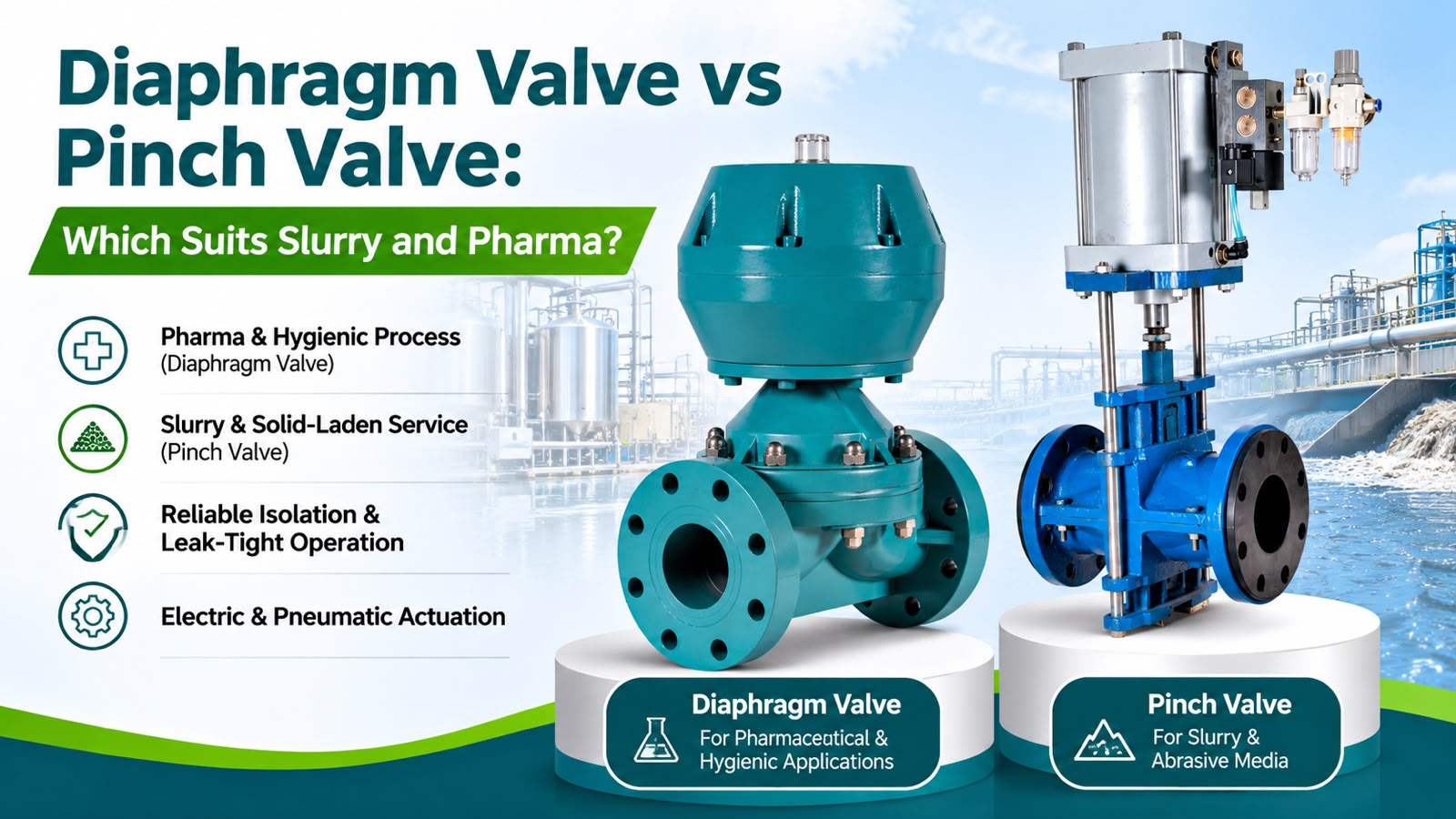
Diaphragm Valve vs Pinch Valve: Which Is Better for Slurry and Pharma Applications?
- Valve
- Nov 15, 2026
- 3 Views
Diaphragm Valve vs Pinch Valve: Which Is Better for Slurry and Pharma Applications?
Selecting the right industrial valve becomes particularly important when handling abrasive slurries, corrosive chemicals or contamination-sensitive pharmaceutical fluids. The wrong valve design can lead to premature wear, leakage, frequent maintenance and process interruptions.
Two valve types commonly considered for these applications are diaphragm valves and pinch valves. Both use flexible components to control fluid movement, but their construction, sealing mechanisms and application suitability are different.
A diaphragm valve uses a flexible membrane that presses against a valve seat or weir to regulate or isolate flow. A pinch valve works by compressing a flexible elastomer sleeve, creating a full-bore shut-off without exposing the process medium to internal metal components.
So, which one should you choose?
For pharmaceutical and hygienic processing, a suitably designed stainless steel diaphragm valve is generally the stronger choice. For abrasive slurry, solid-laden fluids and demanding material-handling applications, a pinch valve often offers better suitability.
SUDE Engineering Pvt. Ltd. offers both solutions, including its hygienic 1168 Series diaphragm valve and 9850 Series electric diaphragm valve, along with 1650-SP electric and 1660-SP pneumatic pinch valve configurations.
Let's understand the differences and identify the right valve for each application.
What Is a Diaphragm Valve?
A diaphragm valve is a linear-motion valve that uses a flexible diaphragm to control or stop fluid flow.
The diaphragm moves downward against a specially designed seat or weir, closing the flow passage. When the valve opens, the diaphragm moves away from the seating surface, allowing fluid to pass.
One of its most important characteristics is the separation between the operating mechanism and process media.
This arrangement reduces the possibility of stem leakage and prevents the process fluid from directly contacting the valve's moving operating components.
Key Features of Diaphragm Valves
Flexible diaphragm sealing mechanism.
Isolation between operating components and process media.
Suitable for hygienic and contamination-sensitive applications.
Available in weir-type and straight-through designs.
Suitable for selected corrosive and slurry services.
Manual, electric and pneumatic operating configurations.
Easy diaphragm inspection and replacement.
SUDE Diaphragm Valve Solutions
SUDE offers diaphragm valve solutions for hygienic processing, pharmaceutical manufacturing, biotechnology, food and beverage, and selected industrial applications.
1168 Series – Pneumatic Diaphragm Seated Stainless Steel Valve
The 1168 Series features an SS316L stainless steel body, hygienic Tri-Clamp connections and a flexible diaphragm arrangement.
Important specifications include:
Valve size: 15 mm to 100 mm.
Body material: SS304 / SS316 / SS316L.
Sealing materials: EPDM / PTFE.
Internal surface finish: Ra ≤ 0.4 μm.
External surface finish: Ra ≤ 0.8 μm.
Optional electropolished finish.
Media temperature: –10°C to +140°C.
Pilot air pressure: 4.5 to 8.0 bar.
Single-acting and double-acting actuator options.
The product is designed for WFI distribution, purified water loops, clean steam, CIP/SIP systems and sterile fluid handling.
9850 Series – Electric Actuator with Diaphragm Valve
SUDE also offers the 9850 Series, featuring SS316L construction and electric ON/OFF or modulating operation.
Its published size range is DN15 to DN50, with optional electro-polished finishing and hygienic connection configurations.
Explore SUDE Diaphragm Valve Solutions.
What Is a Pinch Valve?
A pinch valve is an industrial flow-control valve that uses a flexible elastomer sleeve as its primary sealing component.
Instead of moving a gate, ball or disc against a fixed seat, the valve compresses the sleeve to stop fluid flow.
When the valve is open, the sleeve returns to its original shape, creating a full-bore, straight-through passage.
When the valve closes, an external operating mechanism compresses the sleeve until the passage is completely restricted.
Because the process fluid contacts the sleeve rather than the internal mechanical components, pinch valves are particularly suitable for abrasive and solid-laden media.
Key Features of Pinch Valves
Full-bore, straight-through flow passage.
No conventional internal valve seat.
No metal contact with process media.
Flexible elastomer sleeve construction.
Suitable for abrasive and corrosive media.
Reduced risk of clogging and material accumulation.
Self-cleaning flow path.
Replaceable sleeve construction.
Electric and pneumatic actuation options.
SUDE Pinch Valve Solutions
SUDE offers two principal automated pinch valve configurations.
1650-SP Series – Electric Operated Pinch Valve
This series uses an electric actuator to compress the flexible elastomer sleeve.
Published specifications include:
Operation: ON/OFF and modulating.
Body material: Cast steel, carbon steel or fabricated steel.
Sleeve materials: Natural rubber, pure gum rubber, neoprene, EPDM, nitrile and Hypalon.
End connections: Flanged, ANSI Class 150 / PN10 / PN16.
Power supply: 230 V AC single-phase or 415 V AC three-phase.
Pressure rating: Up to 10 bar, application dependent.
Optional PLC/DCS integration.
4–20 mA and 0–10 V control options.
1660-SP Series – Pneumatic Operated Pinch Valve
This series uses a double-acting pneumatic cylinder to compress the sleeve.
Published construction details include:
Body material: Cast steel ASTM A216 Gr. WCB.
Sleeve material: Pure gum rubber or reinforced neoprene rubber.
Double-acting pneumatic cylinder.
Flanged ANSI Class 150 connection.
Sleeve/seat test: 10 bar.
Body test: 10 bar.
Epoxy-coated body.
Manual and automated control accessories.
The product is designed for slurry transport, abrasive media handling, powder transfer and bulk material processing.
Explore SUDE Pinch Valve Solutions.
Diaphragm Valve vs Pinch Valve: Key Differences
Although both valves use flexible sealing components, their internal construction creates different performance characteristics.
1. Sealing Mechanism
A diaphragm valve uses a flexible membrane that moves against a seat or weir to close the flow passage.
A pinch valve uses an elastomer sleeve that compresses to create the shut-off.
The main difference is that a diaphragm valve seals against a defined seating surface, while a pinch valve closes by squeezing its flexible sleeve.
2. Flow Passage Design
Diaphragm valves are available in weir-type and straight-through designs.
Weir-type designs have a raised internal section that supports the diaphragm sealing arrangement.
Pinch valves have a full-bore, straight-through sleeve design without conventional internal seats or cavities.
This makes pinch valves particularly useful for media containing suspended solids and abrasive particles.
3. Resistance to Abrasive Slurry
Pinch valves are especially suitable for abrasive slurry because the fluid passes through the flexible sleeve without directly contacting metal valve components.
Their unobstructed flow passage also reduces the possibility of particles collecting around conventional valve seats.
Diaphragm valves can handle selected slurry applications, particularly with suitable straight-through construction. However, abrasive particles and repeated contact with the diaphragm can increase wear depending on the process.
For highly abrasive mineral slurry, pinch valves are generally the more appropriate starting point.
4. Pharmaceutical and Hygienic Applications
Diaphragm valves have an important advantage in pharmaceutical manufacturing because their flexible sealing arrangement can isolate the operating mechanism from the process media.
Specialized hygienic designs also offer smooth internal surfaces, appropriate material selection and hygienic connections.
SUDE's 1168 Series is specifically designed for pharmaceutical, biotechnology, dairy and clean-utility applications.
Its SS316L construction, Ra ≤ 0.4 μm internal surface finish, optional electropolishing and Tri-Clamp connections support contamination-sensitive processing.
Pinch valves can be useful in certain pharmaceutical material-handling applications, but they should not automatically be considered interchangeable with validated hygienic diaphragm valves.
The sleeve material, cleanability, extractables, compatibility and process-validation requirements must be checked before selection.
5. Maintenance Requirements
Diaphragm valves generally require inspection and replacement of the flexible diaphragm according to operating conditions and service life.
Pinch valves require periodic sleeve inspection and replacement depending on the abrasiveness of the process medium, operating frequency and compression cycles.
In abrasive slurry applications, sleeve replacement can be a practical maintenance approach because the sleeve is the primary wetted wear component.
Diaphragm Valve vs Pinch Valve: Technical Comparison
Parameter | Diaphragm Valve | Pinch Valve |
|---|---|---|
Sealing component | Flexible diaphragm | Elastomer sleeve |
Closing mechanism | Diaphragm presses against seat/weir | Sleeve compression |
Flow passage | Weir or straight-through | Full-bore straight-through |
Main advantage | Hygienic isolation | Abrasion resistance |
Process contact | Diaphragm and body wetted surfaces | Sleeve |
Slurry suitability | Depends on design and particle characteristics | Particularly suitable for abrasive slurry |
Pharma suitability | Strong for hygienic designs | Requires specific validation |
Clogging potential | Depends on internal geometry | Reduced by cavity-free sleeve design |
Maintenance | Diaphragm replacement | Sleeve replacement |
Automation | Electric / pneumatic | Electric / pneumatic |
Typical application | Pharma, biotech, food, chemicals | Mining, slurry, wastewater, cement |
Actual performance and operating limits depend on the selected construction, materials and process conditions.
Which Valve Is Better for Slurry Applications?
For applications involving abrasive slurry, thick fluids, suspended solids and corrosive material mixtures, a pinch valve is often the preferred solution.
Its full-bore design allows process material to pass through the flexible sleeve without encountering conventional internal seats or moving metal components.
This is particularly useful in applications where abrasive particles can cause damage to conventional sealing surfaces.
Industries Where Pinch Valves Are Commonly Used
1. Mining and Mineral Processing
Mining operations transport mineral slurry, tailings and abrasive mixtures through pipelines.
Pinch valves are useful in these systems because the flexible sleeve isolates the process material from the valve's internal mechanical components.
2. Cement and Fly Ash Handling
Cement and fly ash systems handle abrasive powders and solid-laden materials.
The straight-through sleeve arrangement supports flow control in suitable pneumatic and mechanical material-handling systems.
3. Wastewater Treatment
Wastewater and effluent systems can contain suspended solids and other materials that create challenges for conventional valve designs.
Pinch valves can provide suitable isolation and flow-control solutions for selected applications.
4. Pulp and Paper Processing
Pulp and paper facilities handle fibrous and viscous process materials.
The full-bore passage of a pinch valve makes it useful for suitable applications involving fibres and solid-laden fluids.
5. Chemical Processing
Certain chemical processes involve corrosive and abrasive mixtures.
Selecting an appropriate sleeve material is essential to ensure compatibility with the process medium.
Which Valve Is Better for Pharmaceutical Applications?
For pharmaceutical manufacturing, a hygienically designed diaphragm valve is generally the stronger choice.
Pharmaceutical processes require careful control over contamination, surface finish, cleaning procedures and material compatibility.
SUDE's 1168 Series is specifically developed for hygienic and high-purity applications.
Its key features include:
Precision-machined SS316L body.
EPDM and PTFE sealing options.
Smooth internal surface finish of Ra ≤ 0.4 μm.
Optional electropolishing.
Hygienic Tri-Clamp connections.
CIP/SIP-compatible design.
Isolation between actuator and process media.
Pneumatic actuation with position feedback options.
Pharmaceutical Applications
1. Purified Water Systems
Diaphragm valves can be used in purified water distribution loops where hygienic flow control is essential.
2. Water for Injection (WFI)
SUDE identifies WFI distribution among the applications of its 1168 Series.
3. Clean Steam Systems
Hygienic diaphragm valve configurations are suitable for selected clean steam applications.
4. CIP/SIP Systems
Clean-in-place and steam-in-place systems require suitable valve construction and material compatibility to support cleaning and sterilization procedures.
5. Biotechnology and Sterile Processing
The diaphragm arrangement helps separate the actuator mechanism from process media, supporting contamination-sensitive manufacturing environments.
Explore SUDE Pharma & Biotech Solutions.
How to Select Between a Diaphragm Valve and Pinch Valve
Before finalizing a valve, evaluate the actual process conditions rather than choosing solely on the basis of valve type.
Consider these factors:
1. Process Medium
Identify whether the application involves pharmaceutical fluids, chemicals, abrasive slurry, wastewater or solid-laden mixtures.
2. Solids Content
Evaluate particle size, concentration, abrasiveness and the possibility of material accumulation.
3. Material Compatibility
For diaphragm valves, evaluate body and diaphragm compatibility.
For pinch valves, verify the sleeve material against the chemical composition and temperature of the process medium.
4. Pressure and Temperature
Confirm the design pressure and operating temperature for the selected valve and its flexible sealing component.
5. Cleaning Requirements
Pharmaceutical applications may require validated CIP/SIP procedures, suitable surface finishes and hygienic connections.
6. Maintenance Requirements
Consider the expected replacement frequency and accessibility of diaphragms or sleeves.
7. Actuation Requirements
Determine whether electric or pneumatic actuation is suitable for the available utilities and required automation.
A detailed review of these parameters helps identify the appropriate valve for the intended process.
Why Choose SUDE Engineering for Diaphragm and Pinch Valves?
SUDE Engineering offers diaphragm and pinch valve solutions for different industrial flow-control requirements.
Its diaphragm valve range includes hygienic stainless steel configurations designed for pharmaceutical and high-purity processes.
Its pinch valve range includes electric and pneumatic configurations developed for abrasive, corrosive, viscous and solid-laden media.
Key product capabilities include:
Hygienic SS316L diaphragm valve construction.
EPDM and PTFE sealing options.
Optional electropolished finishing.
Tri-Clamp hygienic connections.
Electric and pneumatic diaphragm actuation.
Electric and pneumatic pinch valve configurations.
Multiple elastomer sleeve material options.
Full-bore pinch valve construction.
ON/OFF and modulating operating options.
PLC/DCS integration options.
For application-specific product information, explore the SUDE Diaphragm Valve Range and SUDE Pinch Valve Range.
Frequently Asked Questions
1. What is the main difference between a diaphragm valve and a pinch valve?
A diaphragm valve uses a flexible membrane that presses against a seat or weir to control flow. A pinch valve compresses an elastomer sleeve to stop the flow through a full-bore passage.
2. Which valve is better for abrasive slurry?
A pinch valve is generally more suitable for highly abrasive slurry because its flexible sleeve protects the internal mechanical components from direct contact with the process medium.
3. Which valve is better for pharmaceutical applications?
A hygienically designed diaphragm valve is generally preferred for pharmaceutical processes because of its contamination-control features, stainless steel construction, smooth surface finish and hygienic connection options.
4. Can diaphragm valves handle slurry?
Yes. Diaphragm valves can handle selected slurry applications. However, their suitability depends on particle size, concentration, abrasiveness and whether the valve uses a weir-type or straight-through design.
5. Why are pinch valves suitable for solid-laden fluids?
Pinch valves use a flexible sleeve with a full-bore, straight-through passage. This design eliminates conventional internal seats and cavities where solid particles can accumulate.
6. What materials are available for SUDE pinch valve sleeves?
SUDE lists natural rubber, pure gum rubber, neoprene, EPDM, nitrile and Hypalon options across its electric pinch valve specifications. Its pneumatic product page specifically lists pure gum rubber and reinforced neoprene.
7. What materials are used in SUDE diaphragm valves?
The 1168 Series offers SS304, SS316 and SS316L body options, with EPDM and PTFE sealing materials.
8. Are SUDE diaphragm valves suitable for CIP/SIP systems?
SUDE identifies its 1168 Series for CIP/SIP systems, WFI distribution, purified water loops and clean steam applications.
9. Are pinch valves available with electric and pneumatic actuators?
Yes. SUDE offers the 1650-SP electric-operated pinch valve and the 1660-SP pneumatic-operated pinch valve.
10. Can both valve types be automated?
Yes. SUDE offers electric and pneumatic actuation configurations for both product categories, with control and feedback accessories depending on the selected model.
Conclusion
Diaphragm valves and pinch valves are both useful solutions for industrial flow control, but their suitability depends on the application.
For pharmaceutical manufacturing, biotechnology, clean utilities and contamination-sensitive processing, a hygienically designed diaphragm valve offers important advantages.
For mining, abrasive slurry, wastewater, cement and solid-laden material handling, a pinch valve provides a practical solution through its full-bore elastomer sleeve construction.
SUDE Engineering offers both technologies, allowing industries to select the right valve based on process requirements, material compatibility, operating conditions and maintenance considerations.
If you are evaluating a Diaphragm Valve vs Pinch Valve for slurry or pharmaceutical applications, explore the SUDE product range or contact its engineering team for application-specific guidance.
Related Posts
- Nov 18, 2026
- SUDE
- 10
Zero-Bacteria Valves for Pharma & Food Processing: Hygienic Design Explained
Explore More