

Process Control Valves
- Valve
- Jul 11, 2026
- 179 Views
Process Control Valves
Process Control Valves: Types, Working Principle, Applications & Selection Guide
Modern process plants depend on precise control of flow, pressure, temperature, and level to maintain stable and efficient operations. A small change in a process variable can affect product quality, energy consumption, equipment safety, and overall plant performance.
This is where process control valves become essential.
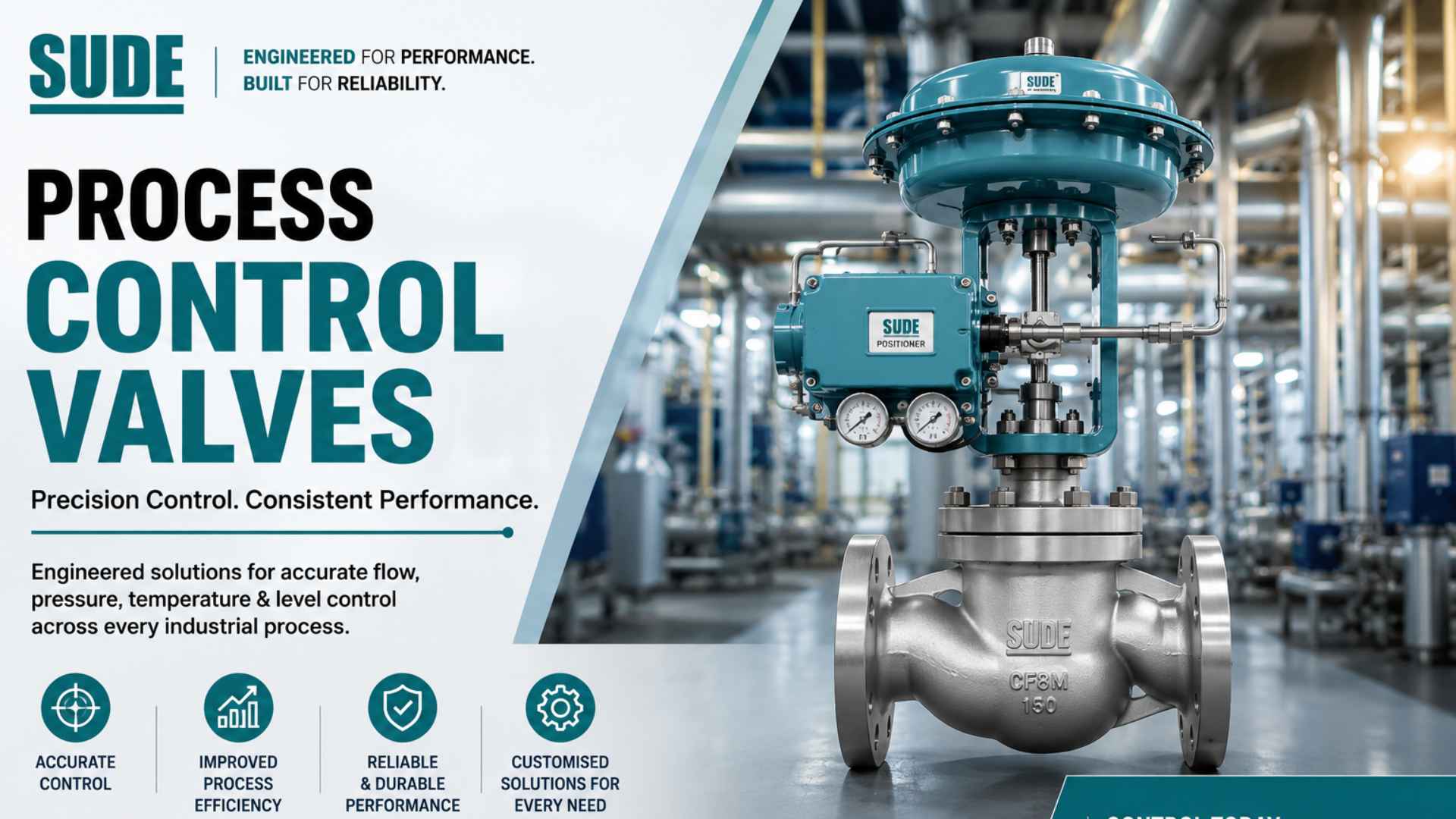
A process control valve is an automatically operated valve assembly that adjusts the flow of a liquid, gas, steam, or other process medium in response to a control signal. Unlike a simple isolation valve that is primarily intended to open or close a line, a control valve is part of a wider control loop and continuously responds to changing process conditions. Emerson describes the control valve assembly as typically comprising the valve body, internal trim, actuator, and accessories, while SUDE explains that its control valves regulate flow, pressure, temperature, or level by varying the flow passage.
For industries such as chemical processing, oil and gas, power generation, water treatment, pharmaceuticals, HVAC, and general process manufacturing, selecting the right control valve can directly influence process stability and reliability.
What Are Process Control Valves?
Process control valves are final control elements used to manipulate the flow of process media and keep a process variable close to a desired setpoint.
A typical control loop may contain:
A sensor or transmitter that measures a process variable
A controller that compares the measurement with the setpoint
A control signal sent to the valve
An actuator that moves the valve
A valve body and trim that alter the flow
The control valve converts the controller's output into a physical change in process flow.
For example, if a temperature transmitter detects that a process temperature is increasing above its setpoint, the control system can adjust the control valve position to reduce or increase the flow of heating or cooling media.
SUDE's control-valve description identifies the valve body, actuator, and positioner as key parts of a control valve assembly. The positioner helps the valve reach the required position based on the control signal.
How Do Process Control Valves Work?
The basic principle is simple: change the valve opening to change the flow rate.
But the actual process involves several interacting components.
Step 1: Measuring the Process
A sensor or transmitter measures a variable such as:
Flow
Pressure
Temperature
Level
The measured value is transmitted to the control system.
Step 2: Comparing With the Setpoint
The controller compares the measured process value with the desired setpoint.
If there is a difference, the controller calculates the appropriate corrective output.
Step 3: Sending the Control Signal
The controller sends a signal to the valve actuator or its associated positioner.
The signal may be electrical, pneumatic, or converted between formats through suitable instrumentation.
Step 4: Moving the Valve
The actuator provides the force needed to move the closure element.
Depending on the valve design, the closure element may be a plug, ball, disc, or another element. SUDE offers electric and pneumatic 2-way and 3-way globe control valves within its control-valve portfolio.
Step 5: Stabilising the Process
As the valve changes position, the flow changes. The process variable moves toward the desired setpoint, and the control loop continues to make adjustments as operating conditions change.
This closed-loop behaviour is what differentiates a control valve from a basic manually operated isolation valve.
Main Components of a Control Valve
Understanding the individual components makes it easier to select and troubleshoot a control valve.
Valve Body
The valve body contains the flow passage and houses the primary internal components.
It must withstand the process pressure and temperature and remain compatible with the process medium.
Trim
Trim generally refers to the internal flow-control components that influence the relationship between valve position and flow.
Depending on the valve design, these can include plugs, seats, cages, discs, or other internal components.
The trim selection affects flow capacity, controllability, pressure drop, noise, cavitation resistance, and material compatibility.
Actuator
The actuator provides the mechanical force required to move the valve.
Actuators can be:
Pneumatic
Electric
Hydraulic
ISA's control-valve actuator work specifically addresses the forces acting on closure components and the sizing of pneumatic, hydraulic, and electric actuators.
Positioner
A positioner helps ensure that the valve reaches the commanded position.
It is particularly important where accurate and repeatable valve positioning is required.
Accessories
Depending on the application, a control-valve assembly may include equipment such as:
I/P transducers
Solenoid valves
Limit switches
Position feedback
Air-filter regulators
Manual overrides
Positioners
Emerson identifies accessories such as transducers, supply-pressure regulators, manual operators, snubbers, and limit switches as possible parts of a control-valve assembly.
Types of Process Control Valves
There is no single control-valve design that is ideal for every process.
The choice depends on the medium, pressure, temperature, required flow range, control characteristics, leakage requirements, installation conditions, and project specifications.
Globe Control Valves
Globe control valves are widely used when precise regulation is required.
The internal geometry can be engineered to provide suitable flow characteristics and controllability for a specific application.
SUDE's product range includes Electric Operated 2-Way & 3-Way Globe Control Valves in its 1750 Series and Pneumatic Operated 2-Way & 3-Way Globe Control Valves in its 1760 Series.
Electric Control Valves
Electric actuation is useful where electrical power is available and the system requires automated operation, remote positioning, or integration with a plant control system.
SUDE's catalogue lists 2-way and 3-way control valves with electrical actuation and identifies 1750/1760 series control-valve solutions for process, power, and oil industries.
Pneumatic Control Valves
A pneumatic control valve manufacturer designs systems in which compressed air provides the force needed to position the valve.
Pneumatic actuation is widely used in process plants because of its fast response, simple control architecture, and suitability for environments where electrical actuation may not be preferred.
SUDE offers pneumatic 2-way and 3-way globe control valves in its 1760 Series.
Diaphragm-Based Control Valves
Diaphragm designs can be useful for applications requiring isolation of the actuator from the process medium, particularly in hygienic and contamination-sensitive services.
SUDE's 1168 Series pneumatic diaphragm-seated stainless-steel valve is designed for pharmaceutical, biotechnology, food and beverage, dairy, and clean-utility applications, including WFI, purified-water loops, clean steam, CIP/SIP, and sterile fluid handling.
Ball and Butterfly Control Valves
Ball and butterfly designs can also be automated for flow control depending on the required process characteristics.
They can be particularly attractive where compact construction, quarter-turn operation, or large flow passages are important.
The suitability for continuous modulation must be evaluated against the valve's flow characteristics and the application's control requirements.
2-Way vs. 3-Way Process Control Valves
The choice between a 2-way and 3-way control valve depends on the required process function.
2-Way Control Valves
A 2-way valve has one inlet and one outlet.
It is commonly used to regulate flow in a single process path.
Typical applications include:
Flow regulation
Pressure control
Temperature control
Utility control
3-Way Control Valves
A 3-way valve has three flow connections and can be used to divert or mix streams.
Typical applications include:
Mixing hot and cold fluids
Diverting process flow
Temperature control
Bypass arrangements
SUDE offers both electric and pneumatic 2-way and 3-way globe control valves.
Process Applications of Control Valves
Control valves are used anywhere a process variable needs to be automatically maintained within a specified range.
SUDE identifies applications across oil and gas, chemical processing, power, water treatment, HVAC, and other industrial sectors.
Chemical Processing
Chemical plants frequently require accurate control of flow, temperature, pressure, and reagent addition.
Material compatibility is particularly important because chemicals can create corrosion or degradation issues.
Oil and Gas
Oil and gas facilities use control valves across production, processing, utilities, and supporting systems.
The valve selection must consider pressure, temperature, hydrocarbons, corrosion, hazardous-area requirements, and the applicable project standards.
Power Generation
Power plants contain many control loops involving steam, water, fuel, air, cooling systems, and other process media.
Control valves must be selected according to the specific service, pressure, temperature, and required control response.
SUDE lists electric 2-way and 3-way globe control valves among its products for power-generation applications.
Water and Wastewater Treatment
Control valves can regulate water flow, chemical dosing, pressure, and other process variables throughout treatment systems.
HVAC
In HVAC systems, control valves can regulate chilled water, hot water, steam, and other utility flows to maintain temperature and system conditions.
Pharmaceutical Manufacturing
Pharmaceutical plants often require a combination of process control and hygienic design.
For critical clean-utility applications, valve materials, surface finish, dead-leg minimisation, cleanability, and process isolation can become important selection criteria.
SUDE's hygienic 1168 Series is designed with SS316L construction and a diaphragm arrangement intended to isolate the actuator from the process medium.
Why Control Valve Sizing Is Important
Valve selection is not simply about matching the valve's nominal size to the pipeline.
An incorrectly sized control valve can create serious operating problems.
Oversized Control Valve
An oversized valve may operate close to its closed position for much of the time.
This can reduce effective control resolution and make stable modulation more difficult.
Undersized Control Valve
An undersized valve may not provide sufficient flow at maximum demand.
This can limit plant capacity or prevent the process from reaching the required operating condition.
Correctly Sized Control Valve
The aim is to select a valve that provides the required flow range while maintaining suitable control authority and stable operation.
ISA maintains dedicated work on control valve sizing equations, including the ISA 75.01 standard series for determining sizing relationships.
For a serious process-control project, valve sizing should therefore be based on actual process data rather than simply selecting a valve equal to the line size.
What Information Is Needed to Select a Process Control Valve?
A control-valve manufacturer or engineering team will typically need information such as:
Fluid or gas being controlled
Minimum, normal, and maximum flow
Upstream pressure
Downstream pressure
Differential pressure
Operating temperature
Density or specific gravity
Viscosity
Vapour pressure for liquids
Gas properties for compressible media
Required shut-off condition
Desired control range
Pipeline size
Valve connection requirements
Available actuator utilities
Fail-open or fail-closed requirement
Environmental conditions
The more complete the process data, the more accurately the valve can be sized and configured.
How to Choose a Control Valve Manufacturer
Choosing the right control valve manufacturer is important because the valve, actuator, positioner, and accessories must work together as one control assembly.
A reliable manufacturer should be capable of supporting:
Engineering and Sizing
The manufacturer should understand the process conditions and recommend a suitable valve configuration.
Actuator Selection
Actuator sizing must account for the forces acting on the valve closure element.
ISA's work on actuator sizing specifically considers forces, actuator characteristics, piston or diaphragm area, and spring characteristics in determining the appropriate actuator size.
Trim Selection
Different process conditions may require different trim configurations and materials.
Trim selection can affect controllability, erosion resistance, noise, and service life.
Automation Integration
The valve may need to communicate with a PLC, DCS, or other control platform through an appropriate positioner and feedback arrangement.
SUDE states that its products are designed for integration with modern automation systems and that its actuators and control solutions support remote operation and compatibility with various control platforms.
Testing and Quality Control
Control valves should be tested according to the product and project requirements before shipment.
Testing may include pressure integrity, functional operation, leakage, actuator operation, and dimensional inspection.
Pneumatic vs. Electric Control Valves
The choice between pneumatic and electric actuation depends on the process and plant infrastructure.
Pneumatic Control Valves
Pneumatic actuation can offer:
Fast response
Reliable repetitive operation
Simple fail-safe arrangements
Suitability for many process environments
Good integration with pneumatic instrumentation
They are particularly attractive when compressed air is already available throughout the plant.
Electric Control Valves
Electric actuation can offer:
Convenient electrical integration
Remote operation
Position feedback
Digital control possibilities
Modulating capability depending on the actuator
The choice should be based on required speed, force, control accuracy, safety requirements, available utilities, environment, and maintenance philosophy.
SUDE's control-valve portfolio includes both electric and pneumatic 2-way and 3-way globe control valves.
Control Valve Characteristics and Process Stability
A control valve does not simply open by a fixed percentage and produce exactly the same percentage change in flow.
The relationship between valve travel and flow depends on the valve's inherent and installed characteristics.
Common flow-characteristic concepts include:
Linear
Equal percentage
Quick opening
The appropriate characteristic depends on the process and the control loop.
A correctly selected characteristic can make it easier for the control system to maintain a stable process across the expected operating range.
This is one reason control-valve selection should be treated as an engineering exercise rather than a catalogue-only purchase.
Maintenance of Process Control Valves
Even a properly selected valve requires inspection and maintenance.
Typical maintenance activities can include:
Checking packing and seals
Inspecting actuator performance
Verifying position feedback
Checking air supply quality for pneumatic systems
Inspecting trim for wear
Checking for abnormal vibration or noise
Verifying calibration
Reviewing leakage or control-performance trends
A control valve that starts requiring increasingly large corrections from the controller may indicate mechanical wear, process changes, incorrect sizing, actuator problems, or instrumentation issues.
Early identification can prevent a small valve problem from becoming a larger process-control problem.
Why SUDE Engineering for Process Control Valves?
SUDE Engineering's current control-valve portfolio includes Electric Operated 2-Way & 3-Way Globe Control Valves and Pneumatic Operated 2-Way & 3-Way Globe Control Valves.
Its catalogue identifies the 1750 and 1760 series as 2-way/3-way control valves with electrical and pneumatic actuation and describes high-gain and high-powered pneumatic control-valve configurations for process, power, and oil industries.
SUDE also positions its broader business around damper and valve automation and the distribution of fluid flow-control equipment, with a manufacturing facility at Dhanore, Alandi Markal Road, near Pune.
Its process-industry portfolio includes control valves, actuators, ball valves, butterfly valves, diaphragm valves, dampers, and other flow-control equipment, allowing projects to combine valve and automation requirements within a broader engineering solution.
Frequently Asked Questions
What is a process control valve?
A process control valve is an automatically operated valve used to regulate process variables such as flow, pressure, temperature, or level. It works as part of a control loop and changes its opening in response to a control signal.
What is the difference between a control valve and an isolation valve?
An isolation valve is primarily used to stop or allow flow, usually in an open or closed position. A control valve is designed to modulate the process and continuously adjust flow to help maintain a target process condition.
What are the main types of process control valves?
Common designs include globe, ball, butterfly, diaphragm, and angle valves. The correct type depends on process conditions and the desired control performance.
What is a pneumatic control valve?
A pneumatic control valve uses compressed air to operate its actuator. Pneumatic actuation is widely used for automated process control because it can provide fast response and can be configured for different fail-safe requirements.
How do I select a process control valve manufacturer?
Look for engineering capability, valve-sizing support, actuator selection, suitable trim options, automation integration, testing, documentation, and experience with your specific process conditions.
What is the difference between a 2-way and 3-way control valve?
A 2-way valve controls flow through a single inlet and outlet path. A 3-way valve has three connections and can be used for mixing or diverting flows.
Does SUDE manufacture pneumatic control valves?
Yes. SUDE offers Pneumatic Operated 2-Way & 3-Way Globe Control Valves under its 1760 Series.
Does SUDE offer electric control valves?
Yes. SUDE offers Electric Operated 2-Way & 3-Way Globe Control Valves under its 1750 Series.
Conclusion
Process control valves are essential final control elements in automated industrial processes. They allow plants to regulate flow, pressure, temperature, and level while responding continuously to changing operating conditions.
The performance of the complete control system depends on more than the valve body. Valve type, trim, actuator, positioner, sizing, process data, control characteristics, installation, and maintenance all have to work together.
For this reason, selecting an experienced control valve manufacturer and providing complete process information during engineering can significantly improve the chances of achieving stable and reliable control.
SUDE Engineering offers electric and pneumatic 2-way and 3-way globe control valves and supports broader valve automation and fluid flow-control requirements for process, power, oil, water, HVAC, pharmaceutical, and other industrial applications.
For projects looking for a process control valve manufacturer or pneumatic control valve manufacturer, the right starting point is a detailed review of the process conditions, required control range, valve sizing, actuator arrangement, and automation requirements.
Explore SUDE Engineering Control Valves:
https://www.sudeengg.com/products/control-valves
Related Posts
- Sep 23, 2026
- SUDE
- 10