
Butterfly Valve Manufacturer: Reliable Flow Control for Modern Industries
- Valve
- Sep 23, 2026
- 9 Views
Butterfly Valve Manufacturer: Reliable Flow Control for Modern Industries
A Butterfly Valve Manufacturer plays an important role in providing efficient flow-control solutions for industries where reliable fluid management is essential. Butterfly valves are widely used because of their simple construction, compact design, lightweight body, and quick operating mechanism. They are suitable for controlling or isolating the movement of liquids, gases, and other compatible media through pipelines. Compared with many conventional valve designs, butterfly valves require less installation space while offering practical operation and dependable performance.
Modern industrial facilities require valves that can operate under different pressure, temperature, and environmental conditions. Manufacturers therefore focus on selecting suitable body materials, disc designs, shaft arrangements, sealing systems, and actuation methods. Depending on the application, butterfly valves can be manually operated or integrated with pneumatic, electric, or hydraulic actuators. Their versatility makes them useful across water treatment, HVAC, chemical processing, food processing, power generation, oil and gas, and general manufacturing industries.
What Is a Butterfly Valve?
A butterfly valve is a quarter-turn valve that uses a circular disc mounted on a rotating shaft to regulate or stop fluid flow. When the valve is fully open, the disc rotates approximately 90 degrees and moves into a position that allows fluid to pass through the pipeline. When the disc rotates back toward the closed position, it blocks the flow. This straightforward operating principle makes butterfly valves easy to install, operate, and maintain.
The internal disc and sealing arrangement are designed according to the required service conditions. Different configurations can be selected for low-pressure water systems, industrial processing lines, corrosive environments, high-temperature applications, and other demanding services. The valve can also be connected to various actuators for remote or automatic operation. Because of their compact construction and relatively low weight, butterfly valves are particularly useful when pipeline space, installation time, and equipment weight are important considerations.
Role of a Butterfly Valve Manufacturer
A professional Butterfly Valve Manufacturer is responsible for designing and producing valves that meet the operational requirements of different industrial systems. Manufacturing involves several stages, including material selection, component machining, body fabrication or casting, disc production, shaft assembly, sealing installation, surface finishing, and performance testing. Every component must work together accurately to provide reliable flow control.
Manufacturers may produce valves in different sizes, pressure classes, body materials, and connection styles. Common materials include cast iron, ductile iron, carbon steel, stainless steel, and specialized alloys. Seat materials can also vary depending on temperature, pressure, chemical compatibility, and the type of medium being handled.
Quality control is another important part of valve manufacturing. Dimensional inspections, pressure tests, leakage tests, actuator checks, and functional testing can help identify manufacturing issues before the valve reaches the customer. Proper quality procedures help improve service life and reduce the possibility of unexpected maintenance or replacement.
Main Components of a Butterfly Valve
Understanding the major components of a butterfly valve helps users select the right configuration for a specific application. Although designs may vary, most butterfly valves include several fundamental parts that work together to provide controlled movement.
Component | Main Function |
|---|---|
Valve Body | Houses the internal components and connects with the pipeline |
Disc | Rotates to control or stop fluid flow |
Shaft/Stem | Transfers rotational movement to the disc |
Seat | Provides sealing between the disc and valve body |
Actuator | Operates the valve manually or automatically |
Bearings | Support smooth shaft rotation |
Bolts/Fasteners | Secure different components where applicable |
The body provides the structural foundation of the valve, while the disc performs the primary flow-control function. The shaft connects the disc with the operating mechanism. Sealing components are particularly important because they help prevent unwanted leakage when the valve is closed. Actuators can be added when automated control is required. Proper coordination between these components determines the valve's overall performance.
Types of Butterfly Valves
Different industrial applications require different butterfly valve configurations. A manufacturer may offer several designs depending on pressure, temperature, pipeline size, media characteristics, and installation requirements.
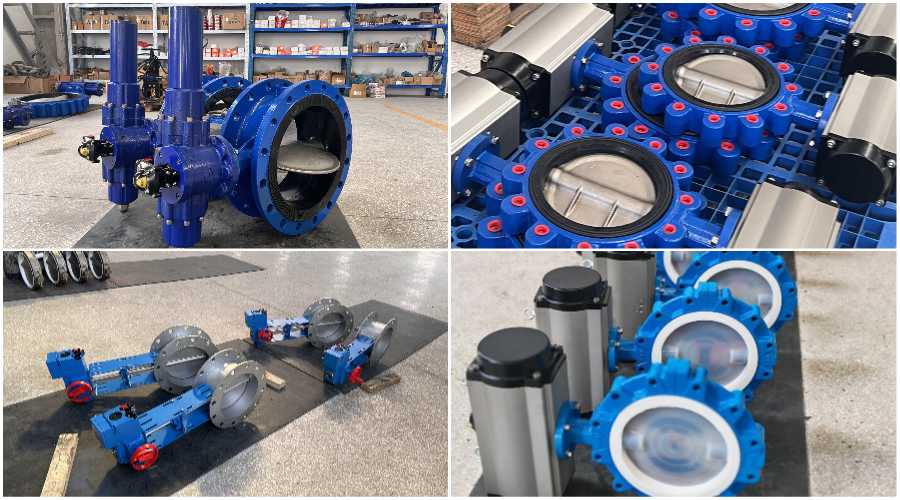
Wafer Butterfly Valve
Wafer butterfly valves are designed to fit between pipeline flanges and are generally compact and lightweight. They are commonly selected where installation space is limited. Their simple design can make installation and maintenance relatively convenient.
Lug Type Butterfly Valve
Lug-type valves feature threaded inserts or lugs around the body that allow them to be mounted between flanges. This configuration can be useful when a section of the pipeline needs to be isolated or removed without disturbing the entire system.
Flanged Butterfly Valve
Flanged butterfly valves are connected directly to pipeline flanges and are often selected for larger or more demanding industrial applications. Their configuration provides a secure connection and can be suitable for systems requiring robust pipeline integration.
Double-Offset Butterfly Valve
Double-offset designs reduce friction between the disc and seat during operation. This arrangement can improve sealing performance and reduce seat wear, making these valves suitable for applications where repeated operation and dependable shutoff are important.
Triple-Offset Butterfly Valve
Triple-offset butterfly valves are designed to provide a cam-like disc movement that minimizes contact between the disc and seat during operation. They are commonly considered for demanding applications involving higher temperatures and pressures where metal sealing may be required.
Materials Used in Butterfly Valve Manufacturing
Material selection is an important factor in determining valve durability and application suitability. A Butterfly Valve Manufacturer may offer different material combinations to meet specific operating conditions. The valve body, disc, shaft, and seat do not necessarily need to use the same material.
Cast iron is frequently used for general-purpose water and utility applications because of its practical mechanical properties and cost considerations. Ductile iron provides improved strength and is commonly used in water distribution and industrial systems. Stainless steel offers better corrosion resistance and can be appropriate for chemical, food, pharmaceutical, and other applications where material compatibility is important.
Carbon steel may be selected for applications requiring greater mechanical strength, while specialized alloys can be used for aggressive or high-temperature services. Seat materials may include elastomers or metal arrangements depending on operating temperature, pressure, and fluid characteristics.
Applications of Butterfly Valves
Butterfly valves are used across many industries because of their compact design and flexible operating options. Water treatment facilities use them for controlling water distribution, filtration systems, pumping stations, and process lines. HVAC systems use butterfly valves for chilled-water and heating-water circuits where reliable isolation and flow management are needed.
In chemical industries, material compatibility becomes particularly important because valves may come into contact with corrosive or reactive media. Food and beverage processing applications may require suitable hygienic materials and finishes. Power plants can use specialized butterfly valve designs in cooling-water and auxiliary systems. Oil and gas facilities may require robust valve configurations for various utility and process applications.
Other common applications include:
Water supply and distribution systems
Wastewater treatment plants
HVAC and building services
Chemical processing facilities
Food and beverage plants
Power generation facilities
Fire protection systems
Irrigation networks
General industrial pipelines
Manufacturing and process plants
Benefits of Using Butterfly Valves
One of the main advantages of butterfly valves is their compact construction. They generally occupy less space than many other valve types, which can simplify installation in crowded pipeline systems. Their relatively low weight can also reduce handling requirements during installation.
Another advantage is quick operation. A quarter-turn mechanism allows the valve to move between open and closed positions with relatively little rotational movement. When combined with pneumatic or electric actuators, butterfly valves can also be incorporated into automated control systems.
Butterfly valves can provide economical flow-control solutions for many large-diameter pipelines. Their relatively simple construction may also contribute to easier maintenance when compared with more complex valve designs. However, the actual performance and suitability depend on the valve design, materials, operating conditions, and application.
Butterfly Valve Selection Factors
Choosing the correct valve requires more than simply matching the pipeline diameter. Operating pressure, temperature, media characteristics, flow requirements, connection type, and actuation method should all be evaluated before selection.
Important factors include:
Pipeline Size: Select a valve suitable for the required line diameter.
Pressure Rating: Ensure the valve is designed for the system's operating pressure.
Temperature: Verify that body, seat, and sealing materials can withstand the operating temperature.
Media Compatibility: Consider whether the fluid can react with valve materials.
Connection Type: Select wafer, lug, flanged, or another suitable configuration.
Operation: Determine whether manual, pneumatic, electric, or hydraulic operation is required.
Sealing Requirements: Consider the required shutoff performance and leakage requirements.
Maintenance: Evaluate accessibility and availability of replacement components.
Correct selection can help reduce operating problems and improve overall system reliability.
Manual and Automated Butterfly Valves
Butterfly valves can be operated manually using handles or gear mechanisms. Manual operation is often suitable for smaller systems or applications where valves do not need frequent remote adjustment. For larger valves, gear operators can make operation easier by reducing the effort required to rotate the shaft.
Automated butterfly valves use actuators to control valve movement. Pneumatic actuators are commonly used where compressed air is readily available and fast operation is required. Electric actuators can be integrated with control systems and are useful when precise remote operation is required. Hydraulic actuation may be considered for specialized heavy-duty applications.
Automation can allow valves to operate according to signals from sensors, controllers, or industrial automation systems. This can support centralized process management and improve operational convenience.
Quality Control in Butterfly Valve Manufacturing
Quality control is essential for producing dependable industrial valves. A Butterfly Valve Manufacturer typically needs to maintain consistency throughout the manufacturing process, from raw-material inspection to final testing. Dimensional accuracy is important because improper alignment can affect valve operation and sealing.
Pressure testing can be performed to evaluate the valve body's ability to withstand specified conditions. Seat leakage testing helps verify the sealing performance when the valve is closed. Functional testing can confirm that the disc, shaft, and actuator operate correctly.
Surface inspection and material verification can also help identify manufacturing defects. For specialized industrial applications, customers may require documentation related to materials, testing, dimensions, and quality procedures. Maintaining proper quality records provides useful information for installation, maintenance, and future replacement.
Why Proper Maintenance Matters
Even a high-quality butterfly valve requires appropriate maintenance to achieve reliable service. Maintenance requirements depend on the valve design and operating environment. Regular inspection can help identify external corrosion, leakage, unusual operating resistance, damaged components, or actuator problems.
Operators should follow the manufacturer's recommended maintenance procedures. Valve movement should be checked where applicable, and sealing components should be inspected when leakage occurs. In automated systems, actuator connections, control signals, and associated equipment should also be checked.
Preventive maintenance can help identify small problems before they develop into larger system issues. Keeping accurate maintenance records can also help plant operators understand valve performance and determine when components may need replacement.
How to Choose a Reliable Butterfly Valve Manufacturer
Selecting the right Butterfly Valve Manufacturer requires consideration of technical capability, manufacturing quality, product range, testing procedures, and application experience. A supplier should be able to provide clear product specifications and help match the valve configuration with the intended operating conditions.
Customers should review factors such as available sizes, pressure classes, materials, connection options, actuator compatibility, testing procedures, and technical documentation. After-sales support and availability of replacement parts can also be important for long-term operation.
For specialized applications, it is useful to communicate complete operating information before ordering. Providing details about fluid type, pressure, temperature, pipeline size, flow requirements, and operating frequency allows the manufacturer to recommend a suitable configuration.
Future Trends in Butterfly Valve Technology
Industrial valve technology continues to develop alongside automation, energy efficiency, and digital monitoring. Modern valve systems are increasingly being integrated with automated control platforms that provide remote operation and status monitoring. Electric and pneumatic actuators can work with industrial control systems to support more efficient process management.
Smart monitoring technologies may also provide information about valve position, operating cycles, actuator performance, and maintenance requirements. These developments can help industries move toward predictive maintenance and improved equipment management.
At the same time, manufacturers continue to focus on material improvements, better sealing technologies, corrosion resistance, and designs that reduce operating requirements. The combination of mechanical reliability and digital control is expected to remain important for modern industrial flow-management systems.
Conclusion
Butterfly valves provide a practical solution for controlling and isolating fluids across a wide range of industrial applications. Their compact construction, quarter-turn operation, flexible materials, and compatibility with different actuation methods make them suitable for water treatment, HVAC, chemical processing, power generation, manufacturing, and many other industries.
A dependable Butterfly Valve Manufacturer focuses on accurate engineering, suitable material selection, controlled manufacturing, reliable sealing, and comprehensive product testing. Choosing the right valve requires careful consideration of pressure, temperature, media, pipeline size, connection style, and operating method. With proper selection, installation, and maintenance, butterfly valves can provide efficient and dependable service for demanding industrial flow-control systems.
Related Posts